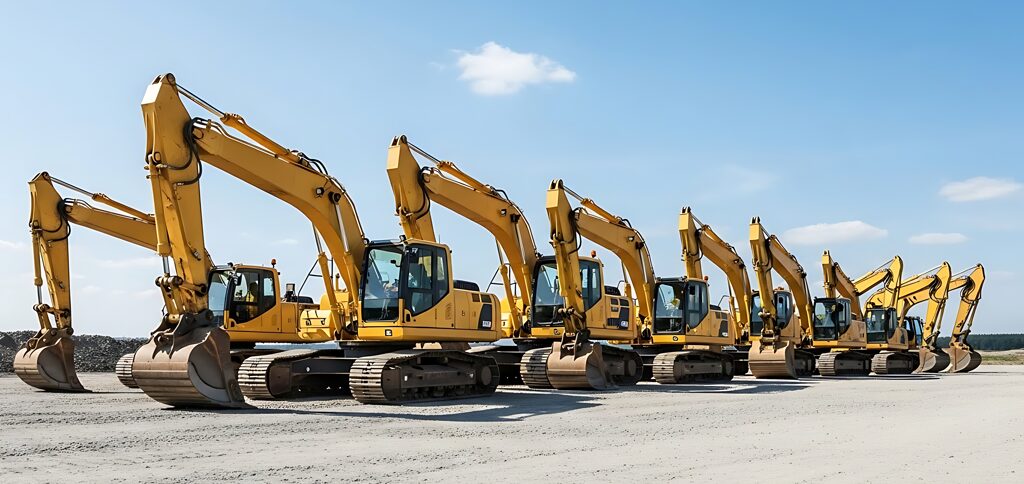
In government and large-scale commercial construction, equipment is often blamed when schedules slip, costs rise, or crews sit idle. The excavator didn’t arrive. The crane showed up late. The generator wasn’t ready. But equipment itself is rarely the real problem.
In today’s construction market, equipment availability is not the limiting factor. Rental fleets are deep, sourcing options are abundant, and capacity generally exists. Projects fail because equipment is not where it needs to be, when it needs to be, in the right condition and with the documentation required to support compliant execution.
That is not an equipment problem. It is an equipment logistics problem.
The Myth of Equipment Availability
Government and regulated construction projects are often planned under the assumption that once equipment is sourced or reserved, its successful deployment is assured. In reality, availability is only the first step in a much longer operational lifecycle.
Between the equipment yard and the job site exists a chain of dependencies that includes:
Transportation planning and carrier coordination
Oversize / overweight permitting and escorts
Delivery window alignment with site access controls
Staging and laydown planning
Inspection and readiness verification
Maintenance status confirmation
Documentation and records control
Failure at any point in this chain introduces schedule risk, cost growth, and potential compliance exposure.
Missed Delivery Windows Become Compliance Issues
Federal, state, and municipal construction projects operate within strict delivery windows driven by traffic control plans, security requirements, environmental constraints, and site logistics.
Missed delivery windows often result in:
Paid crew stand-downs
Equipment standby and demurrage charges
Re-permitting and escort rescheduling
Cascading schedule delays across trades
From a FAR perspective, these impacts quickly raise questions related to cost reasonableness under FAR 31.201-3, particularly when delays result in paid labor or equipment costs without productive output. What begins as a logistics slip can evolve into an audit concern.
Poor Equipment Sequencing Creates Avoidable Risk
Even when equipment arrives on time, poor sequencing can be just as damaging.
Common sequencing failures include:
Equipment arriving before the site is ready
Multiple large assets delivered simultaneously with no staging plan
Equipment delivered out of phase with the approved work plan
Assets blocking access for follow-on trades
In government construction environments, these issues are amplified by safety regulations, access restrictions, and reporting requirements. Repositioning equipment increases handling risk and complicates documentation trails; all of which must withstand audit review.
Idle Crews and FAR Cost Allowability
Idle labor is one of the most expensive downstream effects of equipment logistics failure.
When crews are paid but unable to perform work due to missing or unready equipment, contractors may face challenges justifying those costs under FAR 31.201-2 (Allowability of Costs).
On cost-reimbursable and time-and-materials contracts, repeated idle time can trigger scrutiny related to:
Cost allocability
Schedule management
Adequacy of planning and controls
Effective equipment logistics directly supports audit defensibility, not just operational efficiency.
Transport, Staging, and Records Retention
Transport and staging are often treated as execution details, but in regulated construction they function as control points. Oversized and heavy equipment movements require documented route planning, permits, escorts, and coordination with authorities. When these activities are fragmented across vendors, documentation gaps emerge. In addition, inspection records, maintenance logs, delivery confirmations, and transport documentation must be retained in accordance with FAR 4.703 (Records Retention) and made available for audit.
If records cannot be produced, the work may be questioned, regardless of whether it was performed correctly.
Equipment Readiness Is a Compliance Issue
Equipment that arrives on site but is not operational creates both schedule and compliance risk.
Readiness failures often stem from:
Incomplete inspections
Deferred maintenance
Missing service records
Unclear chain of custody
Under FAR 52.215-2 (Audit and Records — Negotiation), contractors must be able to substantiate costs and execution decisions. Equipment readiness documentation is part of that substantiation.
Availability alone is not sufficient. Readiness must be verified, documented, and traceable.
Why Equipment Logistics Must Be a System
Transactional equipment management breaks down in government and regulated environments.
Effective equipment logistics requires a system-based approach that provides:
Integrated transport planning aligned to the construction schedule
Defined delivery windows and staging strategies
Real-time visibility into equipment location and status
Pre-arrival readiness verification
Centralized documentation and records control
Clear ownership and escalation paths
This approach reduces preventable delays and strengthens audit posture.
The Black Ball Logistics Approach
At Black Ball Logistics, we treat equipment operations as a mission-critical logistics function, not a series of disconnected transactions.
Our approach emphasizes:
Integrated equipment transportation and coordination
Sequencing aligned to approved work phases
Site readiness and staging strategy development
Tracking and status visibility that supports audits
Documentation discipline aligned to FAR expectations
We focus on helping government agencies, primes, and contractors protect schedules, control costs, and maintain compliance, even in complex, high-risk environments.
Equipment Doesn’t Fail Projects, Logistics Does
Equipment is rarely the constraint in modern construction. The real bottleneck is the system that moves it, stages it, prepares it, and documents it. Projects that recognize this treat equipment logistics as a control function: planned, monitored, and audited with the same rigor as cost and schedule. Those that don’t continue chasing symptoms: late deliveries, idle crews, and missed milestones.
Equipment doesn’t fail projects. Poor equipment logistics does.